
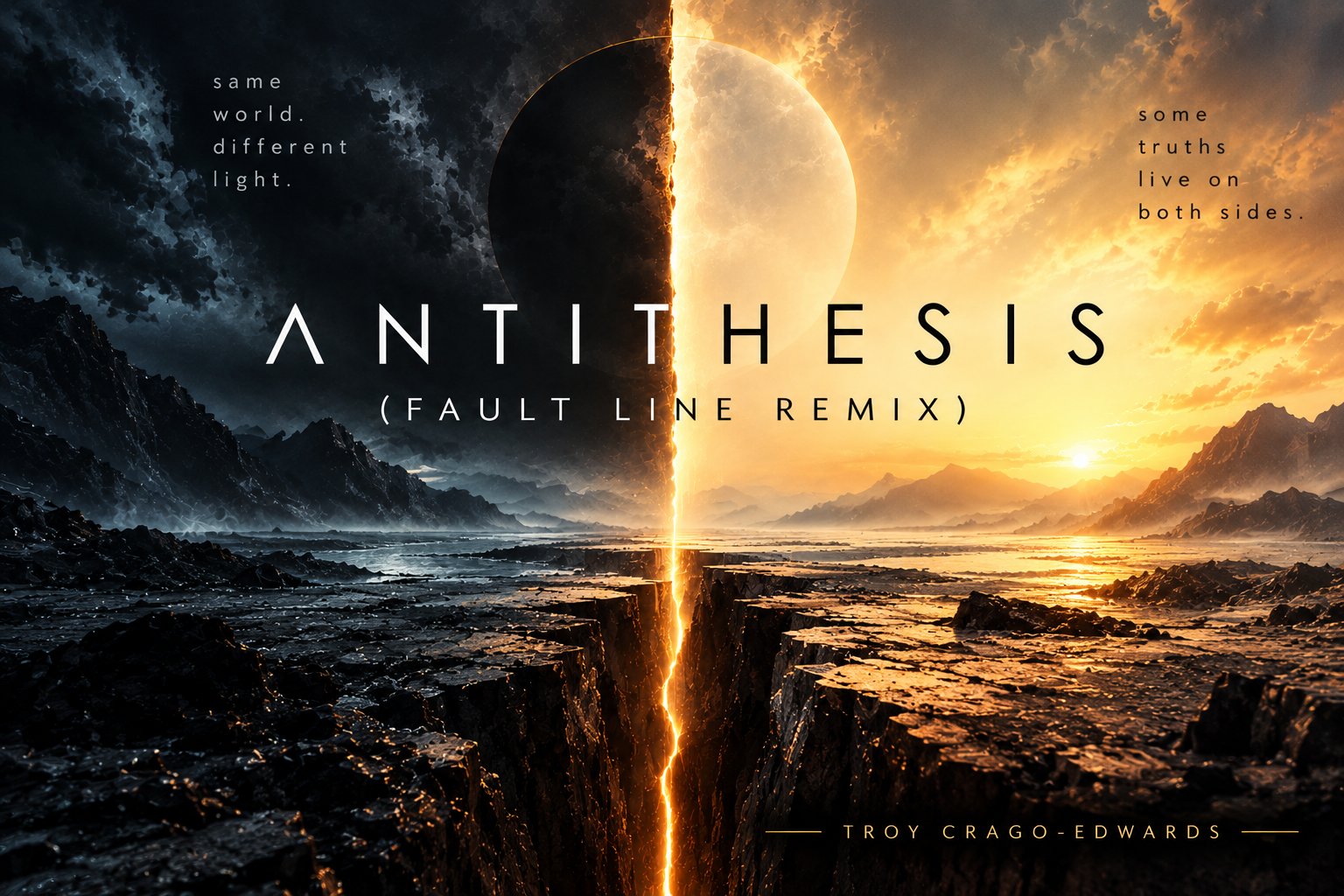
antithesis (fault line remix)
There are songs you rewrite because something was wrong with them.
And then there are songs you return to because nothing was wrong with them at all.
You changed.
antithesis (fault line remix) belongs to the second kind.
The original song was built around contradiction—the uncomfortable realization that two things can be true at exactly the same time. That love doesn't necessarily disappear when a relationship ends. That knowing something is over doesn't require pretending it meant less than it did. That moving forward and looking backward aren't always opposites.
Sometimes they're happening in the same person, in the same moment.
The fault line remix takes that idea and breaks the ground beneath it.
the fault line
A fault line isn't the space between two unrelated things.
It's where two enormous forces meet.
That's what interested me about returning to antithesis.
I've spent a lot of my life trying to reconcile contradictions. Trying to determine which feeling was the real one. Which version of a story was correct. Which emotion I was supposed to keep and which one I needed to get rid of before I could claim I had moved forward.
But I'm beginning to think that was the wrong question.
Maybe maturity isn't resolving every contradiction.
Maybe sometimes it's developing enough room inside yourself to hold both sides without requiring either one to disappear.
I can love someone and know we shouldn't be together.
I can grieve something and still be grateful it happened.
I can miss who I was and have absolutely no desire to become him again.
I can carry the past without asking it to become my future.
Those aren't failures of resolution.
They're antitheses.
And somewhere between them is the fault line.
same world. different light.
The remix became a way of looking at the same emotional landscape from opposite sides.
One side is darker. Heavier. Almost geological—the accumulated weight of everything that happened.
The other has light breaking through.
But I didn't want the darkness to represent something bad and the light to represent something good. That would be too easy.
They're the same landscape.
Neither side invalidates the other.
The darkness contains history. Memory. Loss. Things worth mourning.
The light contains possibility. Movement. Things that haven't happened yet.
And the line separating them isn't really separating them at all.
It's showing where they touch.
some truths live on both sides.
That's probably the thing I understand differently now.
For a long time, I thought healing meant eventually arriving at one clean interpretation of what happened.
Now I think healing may be the moment when you stop demanding one.
There are people who hurt us whom we still love.
There are relationships that needed to end that were nevertheless real.
There are choices we would make differently now that were the best choices the person we were then knew how to make.
There are endings that contain relief.
There are beginnings that contain grief.
And there are moments when you can stand directly on the fault line between two versions of yourself and recognize both of them.
Not enemies.
Not mistakes.
Just two truths produced by the same life.
Maybe that's why I wanted antithesis to exist again in another form.
Not to replace the original.
Not to correct it.
To let the same truth pass through different light.
Because I've spent enough of my life believing that when two things contradict each other, one of them must be wrong.
I'm not sure I believe that anymore.
Sometimes the most honest place to stand is exactly where the ground splits beneath you…
and realize you're still standing.

the song takes as long as the story takes
I was watching a clip recently of a pianist performing on one of the Got Talent shows.
He sat down at the piano and started playing Twinkle, Twinkle, Little Star.
Not exactly unexplored musical territory.
Almost everyone knows those notes. Most of us probably can't remember the first time we heard them. The melody is so familiar that it belongs somewhere alongside nursery rhymes, bedtime stories, and other things we learned before we understood that we were learning them.
But then he started doing something with it.
The melody moved through richer harmonies. Rhythms changed. Jazz harmonies appeared. The music grew more complicated, more playful, more sophisticated. It wandered into places those few childhood notes had seemingly never been before.
And yet they were always there.
You could still hear Twinkle, Twinkle underneath it all.
That was what made the performance extraordinary.
He didn't need to replace something familiar with something new.
He made the familiar sound new.
I came across a sentence describing performances like this that stayed with me:
Great musicians don't change the melody. They transform the way we hear it.
I've been thinking about that sentence ever since.
Because I think it describes what I'm trying to do when I write songs.
.
the melodies we already know
I'm probably never going to invent a new human emotion.
I don't think any of us will.
Love has been written about.
Grief has been written about.
Fear has been written about.
So have leaving and staying. Wanting and losing. Forgiving and regretting. Being lonely in a room with another person. Missing someone you know you shouldn't call. Looking backward and realizing you understand something differently now than you did when you lived it.
We've been writing about these things for as long as we've been writing.
Those are the melodies.
Maybe the job isn't always to find a new one.
Maybe sometimes the job is to take one of those familiar human experiences and listen to it closely enough that you find something inside it you haven't heard before.
That's increasingly how I understand my own songwriting.
I write about things that happened to me, certainly. But the event itself usually isn't the destination.
I'm looking for the thing underneath it.
What did staying teach me?
What did leaving require?
What does forgiveness actually ask of us?
What happens when survival looks so much like strength that we confuse the two?
What happens when something you believed about yourself for decades turns out to have another explanation?
What does it mean to become someone when becoming never actually stops?
The facts of my life belong to me.
The emotions underneath them don't.
Those belong to all of us.
And somewhere between those two things is where I try to write.
.
apparently, my songs are long
I've heard this more than once.
My songs tend to be on the longer side.
It's true.
Five minutes isn't particularly unusual for me. Sometimes a song wanders beyond that.
I understand the observation. I even understand the criticism.
We live in a culture increasingly organized around speed. Get to the point. Get to the hook. Don't lose attention. Make it shorter. Make it shareable. Make it consumable. Give me the TL;DR version. Executive summary this for me.
And there are perfectly legitimate artistic reasons to make something shorter.
Sometimes a verse isn't doing anything.
Sometimes twelve lines are doing the work that eight could do better.
Sometimes we're repeating ourselves because we fell in love with the words instead of paying attention to whether the story still needs them.
Those are problems worth fixing.
So when someone says one of my songs is long, the question I ask myself isn't whether they're wrong.
The question is:
Does every minute still have something to say?
Because if the answer is no, then the song isn't too long because it crossed some arbitrary number on a clock.
It's too long because I stopped telling the story before I stopped singing.
That's different.
And I'll cut that minute.
But I won't cut a minute that the story still needs simply because we've decided songs are supposed to occupy a particular amount of time.
A story cannot always be compressed to accommodate a system increasingly optimized for the mass production and consumption of smaller and smaller pieces of attention.
Sometimes understanding requires another verse.
Sometimes the first chorus tells us what the narrator believes, and the second tells us why that belief is beginning to crack.
Sometimes the bridge isn't a musical obligation. It's the moment everything we've heard for the previous four minutes acquires another meaning.
Sometimes the final thirty seconds are the reason the first four and a half minutes exist.
Take those away and, yes, technically, I have made the song shorter.
I have also told a different story.
I'm not interested in doing that.
.
the people who stay
There's something else I've noticed.
The people who connect with the music don't talk to me about its length.
Someone will tell me they listened to a song again immediately after it ended. They don't mention that it was five minutes long.
Someone will tell me they've had one of the songs playing repeatedly. They don't mention that it could have been forty-five seconds shorter.
Someone will tell me that a lyric stopped them because it described something they had experienced but never quite knew how to explain. They don't tell me I should have gotten to that line sooner.
That's taught me something.
Not that every long song is justified.
Not that criticism about length should be ignored.
And certainly not that holding someone's attention for five minutes makes something profound.
It has taught me that length and feeling are measuring different things.
If someone is waiting for a song to end, five minutes can feel interminable.
If someone is inside the story, five minutes can disappear.
So I've stopped asking:
How long is this song?
And started asking:
Does the listener still have somewhere to go?
If they do, we keep walking.
.
don't lose the melody
That brings me back to Twinkle, Twinkle, Little Star.
What fascinated me wasn't simply that the pianist could make a children's melody sound sophisticated.
It was that no matter how far he traveled from those opening notes, I could still recognize them.
That's important.
Because transformation only means something when we can still recognize what is being transformed.
I think storytelling works the same way.
I can explore all the psychological complexity I want. I can write about contradictions and memory and trauma and identity and the strange ways we reinterpret our own histories.
But somewhere underneath all of it, there needs to be something very simple.
I loved you.
I was afraid.
I wanted you to understand.
I stayed.
I left.
I didn't know.
I'm still here.
That's the melody.
If I bury it beneath so much cleverness that nobody can hear it anymore, I've lost something much more important than a hook.
I've lost the listener.
So this has become a new rule for how I think about writing:
We don't have to invent new human emotions. We make familiar ones audible in ways people haven't heard before.
Every song has a melody beneath the melody.
The simplest human truth underneath everything else.
Find it.
Protect it.
Then see where it can go.
.
as long as it takes
Maybe someday I'll write a song that says everything it needs to say in two minutes and forty-one seconds.
Wonderful.
It ends at two minutes and forty-one seconds.
Maybe another needs six minutes and seventeen.
Then I have six minutes and seventeen seconds to justify.
That's the bargain.
Artistic freedom isn't permission to be self-indulgent. If anything, it creates a harder standard.
Every verse has to earn the next one.
Every chorus has to reveal, deepen, challenge, or transform something.
Every minute has to deserve the minute that follows it.
But I won't confuse brevity with discipline.
And I won't mistake efficiency for storytelling.
Because I'm not trying to manufacture the greatest possible number of songs from the smallest possible amount of attention.
I'm trying to tell the story until the story is told.
Love will still be love.
Grief will still be grief.
Fear will still be fear.
We'll keep staying when we should leave and leaving when part of us still wants to stay. We'll keep discovering things about ourselves that perhaps should have been obvious years ago. We'll keep becoming people we couldn't have imagined when we started.
The melodies aren't new.
They don't need to be.
There are still endless ways to hear them.
That's the work.
Listen closely enough to something familiar that another possibility emerges.
Follow it wherever it needs to go.
And when there's finally nothing left that needs to be said, stop.
Not at three minutes.
Not at five.
Not when an algorithm, convention, or someone's attention span tells you the song should be finished.
When the story is finished.
The story determines the runtime.
The runtime never determines the story.

the way i swam (looking back / reaching back)
Same truth. Different journey.
There is something particularly cruel about criticizing the way someone swims while they're drowning.
I've been sitting with that thought.
Not because drowning is a particularly original metaphor for struggling. We talk about drowning in work, drowning in grief, drowning in responsibility. We say we're barely keeping our heads above water.
But I started thinking about something more specific:
What happens when someone standing safely on the shore starts criticizing the way you're swimming?
Why are you panicking?
Why are you holding onto that?
Why can't you just let go?
Why are you making so much noise?
Why aren't you swimming in a straight line?
Why do you keep going under?
From the shore, perhaps there are better ways to swim.
But there's one rather important detail missing from that analysis.
I wasn't swimming. I was trying not to drown.
And once I understood that distinction, two songs appeared.
Not one song with two possible endings.
Two songs.
Because there were two different places I needed to go with that realization.
.
i forgive the way i swam
Both songs begin in essentially the same place.
For a long time, I looked backward at some of the ways I've survived difficult periods of my life and judged myself for them.
Why did I hold on so tightly?
Why did I react that way?
Why couldn't I see what seems obvious now?
Why didn't I just let go?
Why couldn't I find the shore?
Those questions are remarkably easy to ask once your feet are touching solid ground.
They're much harder to answer honestly if you forget what it felt like when they weren't.
When you're drowning, you grab things.
You panic.
You gasp.
You kick.
You reach.
You may swim toward something that turns out not to be shore.
You may cling to something longer than you should because, at one point, it was the only thing keeping your head above water.
Survival isn't always graceful.
And something can be necessary for survival at one point in your life without being something you need to carry forever.
That's an important distinction for me.
Understanding why I did something isn't the same as deciding I should keep doing it. Compassion for the person I was doesn't require me to remain that person.
It simply means I can stop standing on the shore of my own history criticizing someone who couldn't see what I can see now.
So both songs arrive at the same realization:
I forgive the way I swam.
It got me here.
And that's where the doors open.
.
looking back
In one version, I reach the shore and turn around.
But I don't look toward the water.
I look at the person who was standing on the shore.
And suddenly the question changes.
For years, the question was:
What was wrong with the way I survived?
Now I can ask:
Why were you criticizing me while I was trying to survive?
That isn't the same thing as refusing responsibility for the things we do when we're hurting.
Survival doesn't grant us immunity from accountability. We can understand why we behaved a certain way and still acknowledge the consequences of that behavior.
But accountability and shame aren't the same thing.
And neither are accountability and accepting someone else's interpretation of everything you did to stay alive.
Once I stopped automatically blaming the person in the water, I could finally see the person standing on the shore.
That's where the way i swam (looking back) goes.
It gets angry.
It asks questions I once directed toward myself in the opposite direction.
What did you think drowning looked like?
Did you expect quiet hands and measured breaths?
Was I supposed to sink gracefully enough that my distress didn't inconvenience you?
Was I supposed to make desperation attractive?
And perhaps most importantly:
Why was the person fighting for another breath being evaluated by the person who already had air?
There's anger in that.
I'm okay with the anger.
Because anger isn't always the opposite of healing.
Sometimes anger arrives because healing has finally made enough room for us to recognize that something wasn't okay.
I can forgive the way I swam.
That doesn't mean I have to forgive you for criticizing it.
.
reaching back
The other door opens from exactly the same place.
Same water.
Same drowning.
Same shore.
Same realization:
I forgive the way I swam.
But this time, when I turn around, I look toward the water.
And I see someone else struggling.
That's the way i swam (reaching back).
This version asks a different question:
Now that I understand what I needed, what will I do when someone else needs it?
And the answer isn't rescue.
That's important to me.
I don't think love always means jumping into the water and carrying someone to shore.
Sometimes we can't.
Sometimes doing that would drown both people.
Sometimes the person in the water has to make the journey themselves.
But there is an enormous difference between refusing to drown with someone and standing safely on shore critiquing their technique.
I didn't need someone to swim for me.
I didn't need someone who knew exactly where the shore was.
I didn't even need someone who could make the water calm.
I needed someone close enough to hear:
I'm tired. I can't see the shore.
And answer:
I'm not going away.
That's what the reaching-back version discovers.
People who love us don't necessarily have the power to rescue us.
But they can make survival less lonely.
They can stop adding weight.
They can stop demanding that distress be expressed in whatever form makes them most comfortable.
They can reach.
And sometimes a hand doesn't pull you all the way to shore.
Sometimes it just helps you take another breath.
.
two doors
These songs created something new for me.
I've made alternate versions of songs before. I've revisited songs after time and experience changed what I understood about them.
This is different.
These songs travel together.
They begin with the same experience.
They carry the same wounds.
They ask the same questions.
They arrive at the same shore.
And eventually, they arrive at exactly the same sentence:
I forgive the way I swam.
Then a door opens.
Actually, two of them do.
Through one door, I turn toward the person who stood on shore and finally allow myself to see their actions clearly.
Through the other, I turn toward someone still in the water and decide to offer what I once needed.
I've started thinking of these as Sliding Door songs.
The same truth. The same narrator. The same emotional journey to a particular moment.
And then two doors.
Same truth. Different journey.
Neither song is the original.
Neither is the alternate.
Neither represents the emotionally healthier choice.
Neither exists to correct the other.
And neither is the road not taken.
Both roads get taken.
That's why these songs exist together.
That's why they'll be released together.
Because human beings can encounter exactly the same truth and need to travel in different emotional directions from it.
Sometimes I need to look back.
Sometimes I need to reach back.
Sometimes I need the song that says:
What happened to you wasn't okay.
Sometimes I need the song that asks:
What will you do with what happened to you?
And sometimes I need both.
Anger isn't failed forgiveness.
Compassion isn't denial.
Holding someone accountable doesn't mean you haven't healed.
Choosing to offer someone else what you weren't given doesn't mean you've absolved the person who withheld it.
Those truths can exist together.
Maybe that's the point.
.
which door do you need today?
There's one image connecting both songs that I keep returning to.
A person finally reaches shore.
Their feet touch solid ground.
They can breathe.
For the first time, they can look somewhere other than toward the next wave.
And then they turn around.
In one song, they see the person who stood safely on shore criticizing every desperate stroke.
For the first time, they stop asking what was wrong with the drowning person and start asking what was happening with the person who watched.
Looking back.
Through the other door, they see someone still in the water.
And because they remember exactly what that water felt like, they walk back toward it.
Not far enough to drown again.
Not to become someone's savior.
Just close enough to reach.
Reaching back.
I don't think one of those people is more healed than the other.
I think they're both human.
And maybe tomorrow they'll need to walk through the other door.
What matters to me is what happened before either choice:
The person who spent so long criticizing every frightened, desperate stroke finally looks back at the water and understands:
You were drowning.
You did what you knew how to do.
You kept breathing.
You found the shore.
I forgive the way you swam.
Everything after that is a choice.
And maybe that's why these needed to be two songs.
Because once you finally stop judging yourself for how you survived, there isn't only one direction you're allowed to go.
There isn't one correct door.
Both doors are open.
Which one do you need today?
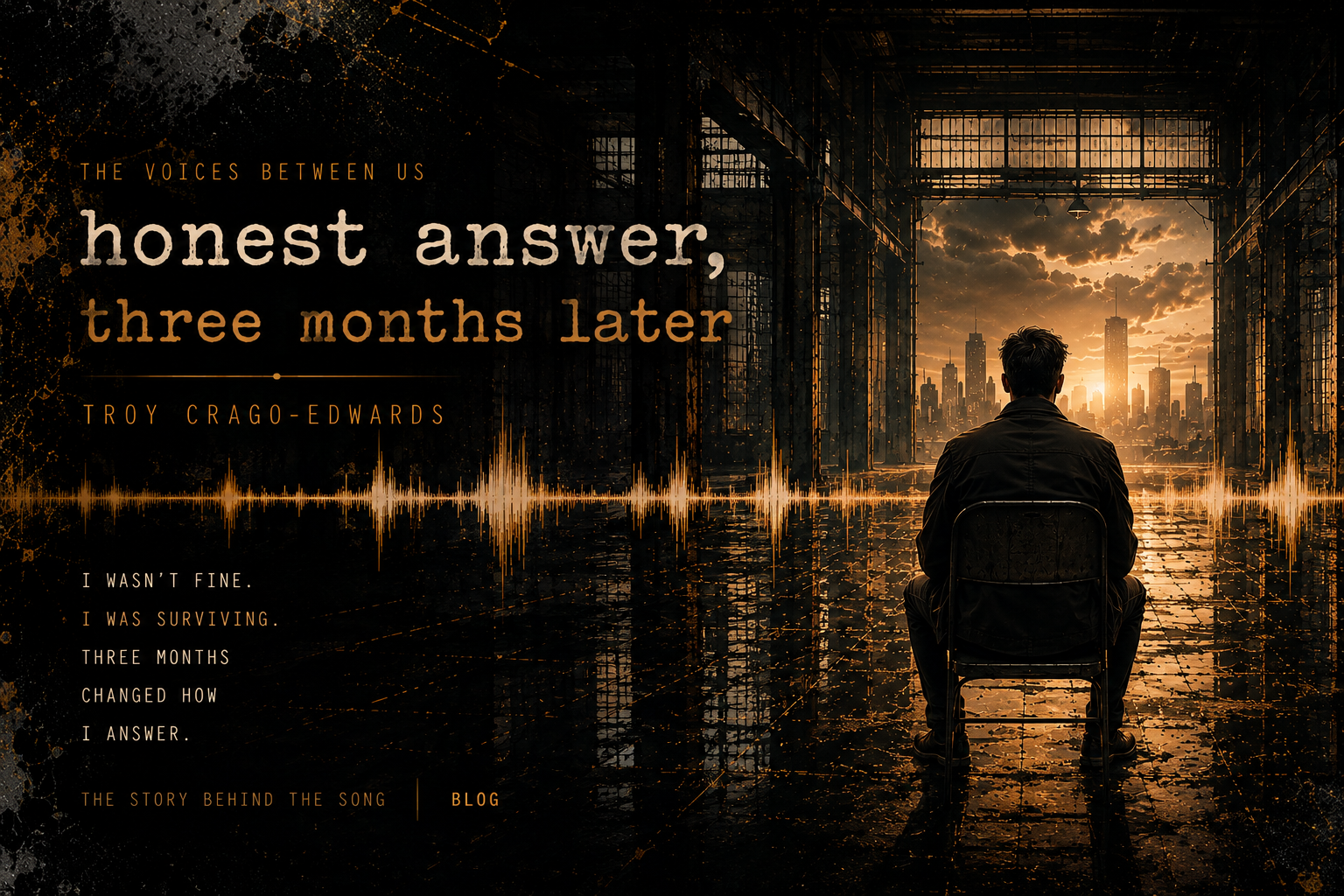
honest answer, three months later
Three months isn’t a very long time.
Except when it is.
Three months ago, I wrote a song called honest answer because I had become tired of answering a very ordinary question with a lie.
How are you?
I'm fine.
I wasn't.
I knew I wasn't when I wrote the song. That was the entire reason for writing it.
I was exhausted in ways sleep didn't fix. My mind rarely stopped moving. I was struggling to keep up while somehow continuing to show up. And because I was still functioning — still working, still laughing, still doing the things expected of me — it was remarkably easy for the world to believe the person standing in front of it was okay.
I had gotten very good at performing okay.
So honest answer was an attempt to stop performing.
It said, essentially: if you're actually asking me how I am, and if I believe you really want to know, then this is what the truth sounds like.
At the time, that felt enormously vulnerable.
Three months later, I realized I still hadn't told the whole truth. Not because I'd been dishonest, but because I didn't know it yet.
There is an important difference, and I have become increasingly interested in that difference.
We tend to think of truth as something fixed. Either we told it or we didn't. Either we understood ourselves or we didn't. Either the story we told about our lives was accurate or it wasn't.
I'm beginning to think that's an unfair expectation to place on ourselves.
Sometimes we tell the absolute truth with every piece of understanding available to us at the time.
And then we live a little longer. Something happens. A memory connects to another memory. A conversation opens a door. Therapy gives something a name. Your body reacts to something before your mind understands why.
And suddenly a truth you thought you understood becomes larger.
The earlier truth wasn't wrong… you just know more now.
That's what happened to honest answer.
I returned to it three months later because I had begun understanding something about myself that changed the meaning of some of the words I'd written.
For much of my life, I have thought of myself as someone who tolerates pain well.
I've said it almost proudly.
I don't complain much. I can endure things. I can keep functioning through pain. I can compartmentalize. I can do what needs to be done and deal with how I feel about it later.
There is a version of that story in which those things are strengths.
Some of them probably are.
But there is another version I had never really considered.
What if I didn't learn to tolerate pain? What if I learned not to show it?
That question landed differently.
Because there are things the body learns long before we have sophisticated language for them.
When I was young, there were circumstances in which reacting to pain could make things worse.
Crying could make things worse.
Pulling away could make things worse.
Resistance could make things worse.
So what does a child learn?
Take it.
Don't react.
Don't make this worse.
Be still.
Be quiet.
Eventually nobody has to tell you anymore.
Your body remembers the instructions.
And years later, you can call the result pain tolerance.
You can call it strength.
You can call it resilience.
Other people might even admire it.
That doesn't mean those words are entirely wrong.
But they may not tell the whole story.
That realization forced me to reconsider something else I have often treated as strength: silence.
I know how to go quiet.
I know how to keep something inside while presenting something entirely different outside.
I know how to walk into a room carrying far more than anyone in that room realizes and still function.
I know how to say I'm okay convincingly enough that people stop asking.
For years, I thought there was something stoic about that.
Now I wonder how much of it was learned.
How much of what I called strength was actually an extraordinarily effective survival strategy?
And perhaps the more uncomfortable question:
What happens when a survival strategy outlives the circumstances that created it?
That's where this new version of the song began.
Not with the idea that honest answer had been wrong, but with the realization that I finally understood something the person who wrote it couldn't yet see.
So I didn't want to write a sequel. I didn't want honest answer, part two. And I absolutely didn't want to rewrite the original as though three months of additional understanding somehow invalidated what I had felt before.
That person deserves better than that.
He told the truth.
He told as much of it as he knew.
So I went back to the song instead.
The new recording begins recognizably close to the original. That's deliberate.
For a while, you're standing in the same place. Then things begin to shift. The music starts moving somewhere else. The familiar structure becomes less familiar.
And by the time the lyrics themselves begin revealing what has changed, you're no longer listening to quite the same song.
I love that.
Because that's much closer to how change actually feels to me. There usually isn't a dramatic moment when one version of ourselves exits and another enters.
We carry the old understanding forward. We walk around in it.
Then one day we notice that something fits differently. A sentence means something it didn't mean before. A memory has acquired context. Something we once admired about ourselves begins asking to be examined.
The landscape hasn't necessarily changed. We have.
There is grief in that.
I don't want to romanticize it.
Discovering that something you considered a strength may have originated as a survival response doesn't magically make the response disappear.
Understanding why I go quiet doesn't mean I will never go quiet again.
Recognizing that my body learned not to resist doesn't erase what taught it that lesson.
Knowing that I'm fine can be a performance doesn't mean I will never say it when I'm not.
Healing, at least as I am experiencing it, is much less tidy than that.
Sometimes healing is simply noticing.
I'm doing that thing again.
And then, perhaps:
I understand why.
And eventually:
Do I still need to?
That last question is the one I'm learning to ask.
Not with judgment.
That's important to me.
I spent enough years judging earlier versions of myself for choices they made with information, circumstances and survival skills I can only fully understand in retrospect.
I don't want healing to become another courtroom. I don't need to prosecute the person I used to be in order to become someone different.
If silence kept him safe, then I can be grateful for the silence.
If disappearing inside himself helped him endure something, then I can understand why he disappeared.
If pretending to be fine got him through another day, then perhaps I'm fine wasn't always a lie.
Maybe sometimes it was a life raft.
But you aren't supposed to live forever on a life raft.
Eventually, if you're fortunate, you reach somewhere safer.
And then comes the difficult part.
You have to learn that the things that kept you alive aren't necessarily the things that will teach you how to live.
That may be the real difference between these two recordings.
Three months ago, honest answer was about finally admitting:
I'm not okay.
Three months later, the question underneath it has become:
Why did I believe I had to hide that in the first place?
I don't have every answer.
I'm becoming increasingly suspicious of songs that pretend I do.
But I know this much:
Silence can look like strength from the outside.
So can endurance.
So can competence.
So can smiling while you're hurting.
Sometimes they genuinely are strengths.
And sometimes they're scars that became useful.
Maybe they can be both.
What matters to me now is having enough compassion for myself to ask which is which.
That's why I wanted this song to carry a timestamp.
three months later.
Not revised.
Not corrected.
Not the real honest answer.
Three months later.
Because I want to leave room for the possibility that three months from now, I'll understand something else.
I hope I do.
I hope there are songs I write today that I'll eventually outgrow — not because they were failures, but because I kept living.
Maybe that is one of the gifts of writing these songs while I'm still inside the journey rather than waiting until I can explain it neatly from the other side.
They become timestamps.
Evidence of what I understood then.
And when understanding changes, I don't have to erase the evidence.
I can return to it with compassion.
I can sit beside the person who wrote those words and tell him:
You weren't wrong. You just didn't know this yet.
Three months ago, I stopped pretending I was fine.
Three months later, I'm learning to stop pretending my silence was strength.
Both answers are honest.
This is simply what the truth sounds like now.
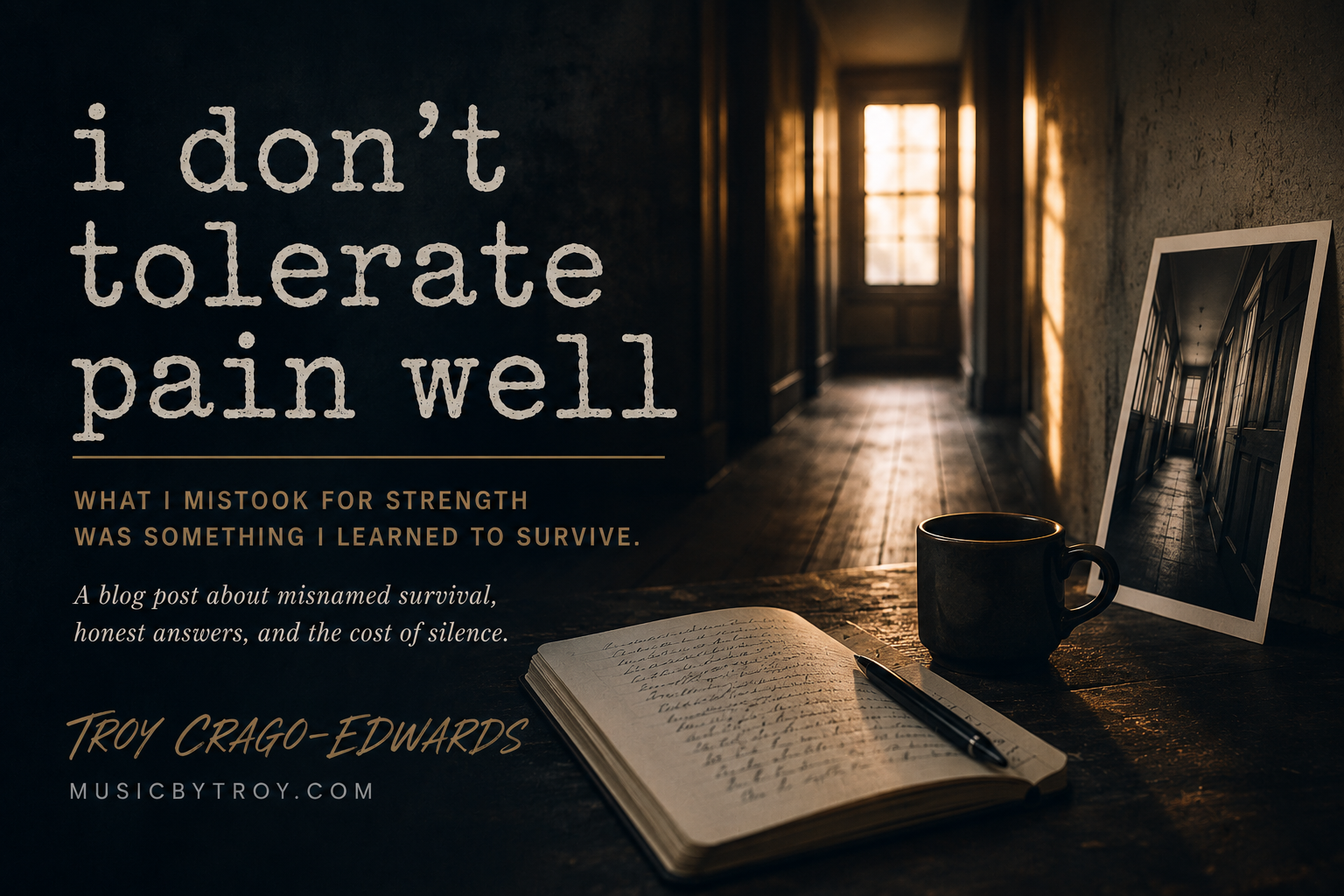
i don’t tolerate pain well
I have said some version of this sentence for most of my life.
I tolerate pain well.
I’ve said it to doctors. I’ve said it to nurses. I’ve said it casually, almost as a fact about myself, the way someone might say they have a good memory or don’t get cold easily.
I tolerate pain well.
I’ve probably been a little too proud of it.
Today, while I was driving, I started wondering if I have been saying it wrong.
I was thinking about the pain I’ve been experiencing in my ankle. It’s significant. It’s there even when I’m sitting still, when I’m not walking on it, when I’m not doing anything that should aggravate it. I have another appointment with my doctor this week, and I was mentally preparing myself to explain what I’m experiencing.
And somewhere in that internal conversation came the familiar thought:
I tolerate pain well.
Except this time, instead of moving past it, something stopped me.
Because I suddenly remembered how I learned to tolerate pain.
When I was a child, being bad could mean being spanked. Sometimes it was a hand. Sometimes it was a belt. Sometimes it was a horse crop.
And there was a rule.
If I cried, the punishment could increase.
If I pulled away, the punishment could increase.
If I reacted too much to what was hurting me, there could be more of the same thing that was hurting me.
Then I went to school.
Corporal punishment was still permitted when I was in elementary and middle school. There were wooden paddles. Some had holes drilled into them, a design intended to make being struck with them hurt more.
And there, adults taught essentially the same lesson.
React, and the punishment increases.
So I learned.
Of course I learned.
But sitting in my car today, decades later, I found myself asking a question I don’t think I had ever asked myself before:
What exactly did I learn?
Did I learn to tolerate pain? Or did I learn not to show it?
Those are not the same thing.
There’s something unsettling about realizing that a characteristic you’ve carried into adulthood, and perhaps even taken pride in, may have begun as a survival strategy.
I’ve always thought of my pain tolerance as evidence I’m tough. Resilient. Strong. I can take a lot.
And that’s true.
I’m not interested in replacing one overly simple story with another. Discovering when something may have originated doesn’t automatically make the thing itself false.
I can withstand a lot of pain.
But today I realized there is additional information attached to that fact.
I learned very young that showing pain could result in more pain.
And as I sat with that realization, I’ve recognized something else.
It wasn’t only showing pain that could make things worse.
It was resisting it.
Pulling away.
Trying to protect myself.
Trying to get away from the thing that hurt.
Resistance could mean more.
So could crying.
So could moving.
The lesson wasn’t simply don’t let them know it hurts.
It was also:
Don’t fight it.
Take it.
Because reacting makes it worse.
Somewhere very young, pain, stillness and endurance became tangled together.
Maybe I didn’t just become good at hiding pain.
Maybe I learned how to remain still inside it.
Maybe I learned that sometimes the fastest way through something painful was not to fight what was happening, but to endure it till it stopped.
That’s a different thing from having a high pain tolerance.
And it’s a difficult thing to recognize as something I learned before I was old enough to understand what I was learning.
So maybe what I’ve been calling pain tolerance all these years is, at least partly, something else.
Maybe I became very good at hurting quietly. And somewhere along the way, I put a bow around that and called it strength.
I’ve been thinking a lot about honesty.
A few months ago, I wrote a song called honest answer. It came from realizing how automatically I answer the question “How are you?” with “I’m fine.” or “I’m okay.”
They’re extraordinarily convenient answers.
Most of us know the exchange.
“How are you?”
“Good. You?”
“Good.”
And everyone gets to keep moving.
But I started experimenting with not doing that.
If I wasn’t okay, I tried not to say I was.
That didn’t mean telling everyone everything. Sometimes it meant giving a slightly more honest answer.
“I’ve had a rough day.”
“I’m struggling a little.”
“Honestly, not great.”
Small sentences, but surprisingly difficult ones.
Eventually, I told someone that I wasn’t doing well, and I was told that what I was doing was manipulation.
That experience hurt deeply.
Not simply because of what was said, but because of something I didn’t understand about myself yet.
I had done the thing I was trying to learn to do. I had said: This hurts.
And somehow, once again, the fact that I had expressed pain became part of the problem.
I want to be careful here.
These experiences are not equivalent. An adult relationship is not my childhood. A painful interaction between two adults is not the same thing as a child being struck with a belt or a horse crop. I have choices now that I didn’t have then.
But experiences don’t have to be identical to echo one another.
Sometimes, something happens in the present and an old lesson recognizes the sound.
There is a line in honest answer that I understand differently today than I did when I wrote it:
“This is what the truth sounds like / when I finally stop performing strength.”
I still believe that line. Completely. But I know more about it now.
When I wrote it, I was thinking about the exhausting performance of being okay. About smiling, functioning, showing up, carrying things, handling things, and becoming so practiced at appearing strong that honesty begins to feel almost unnatural.
Today I find myself wondering how far back that performance actually goes.
Maybe I didn’t simply learn to be strong… maybe somewhere very early, I learned that silence looked like strength.
Don’t cry.
Don’t pull away.
Don’t react.
Take it.
Because reacting makes it worse.
That’s a very different origin story for something I’ve spent decades describing as toughness.
And now I wonder whether what I called strength wasn’t only the ability to endure…
Maybe part of it was the ability not to resist.
To hold still.
To absorb.
To wait for something painful to be over rather than risk making it worse by fighting against it.
And it makes me wonder how many times I’ve mistaken the absense of visible pain, or visible resistance, for evidence of strength, including in myself.
There is another thing I’ve learned since writing that song.
Honesty doesn’t mean everyone is entitled to the honest answer.
There are still people I will tell I’m fine, but something about that has changed, too.
There is a difference between:
“I’m fine because I’m afraid to tell you that I’m not.”
and
“I’m not fine, but I’ve decided that I’m not telling you.”
The words may be identical; the person saying them isn’t.
One can be silence imposed by fear. The other can be a door I have chosen to close.
That’s a distinction I couldn’t have written into honest answer when I wrote it because I hadn’t learned it yet.
It doesn’t make the original song wrong. It makes the song older.
And me three months older with it.
Maybe that’s one of the strange things about making art from your life.
Sometimes you write the truth before you understand everything the truth contains.
But this really isn’t about a song, and I’m beginning to think it isn’t entirely about pain either, because once I questioned this one thing I’ve always believed about myself, an uncomfortable question followed:
What else have I named incorrectly?
What else do I call a personality trait that began as an adaptation?
What else do I call a strength without knowing what it cost me to acquire it?
And I don’t think that question belongs only to people with stories like mine.
Maybe yours isn’t pain.
Maybe you’re fiercely independent.
Maybe everyone admires that you never need anything from anybody.
But have you ever wondered when you learned not to need anyone?
Maybe you’re incredibly good at reading a room/.
You notice tiny changes in someone’s voice. A facial expression. A shift in energy. You know something is wrong before anyone says a word.
Maybe that’s simply a remarkable capacity for empathy.
Or maybe once upon a time when knowing what mood someone was in before they told you mattered.
Maybe you’re the easygoing one, the person who doesn’t make demands. The person who adapts. The person everyone describes as easy to be around.
Maybe that’s genuinely part of who you are.
But maybe it’s worth wondering when you learned that taking up less space made things easier.
I don’t think every strength is secretly a wound.
And I don’t think discovering that something began in survival means we have to stop valuing what it eventually became.
That feels too simple.
Some things we learned because we had to may have become real and valuable parts of who we are.
Maybe the more interesting question isn’t is this actually a strength?
Maybe it’s where did I learn it?
I still don’t know what I’m going to say the next time someone tells me I tolerate pain well.
Maybe nothing.
Maybe I’ll still occasionally say it myself, because, in one sense, it’s true. I can withstand a tremendous amount of pain.
What changed today is that I’m no longer sure that’s the whole story.
There’s a child somewhere in the history of that sentence who learned that crying could make another strike come.
There is a school-aged kid who learned that reacting to the paddle could mean more punishment.
There is an adult who became very good at carrying things without showing how heavy they were.
And there is me, sitting with an ankle that hurts even when I’m not moving it, finally wondering whether being able to ensure pain and being okay with pain were ever the same thing.
They weren’t.
Maybe strength isn’t measured by how quietly we can bleed.
Maybe resilience isn’t just how much we can withstand.
Maybe it’s also worth asking whether endurance was freely chosen, or whether somewhere along the way we learned that resistance would cost us more.
And maybe some of the things we’re proudest of surviving deserve something more complicated than pride.
Maybe they deserve curiosity, compassion, even grief, because sometimes survival leaves us with extraordinary abilities. And sometimes we become so proud of being good at them that we never stop to ask why we had to become good at them in the first place.
So I’m asking now, not because I want to take my strength away from myself, but because I want to know it all.. where it came from, what it gave me, what it cost me…
And whether I still need to pay that price.
I don’t think I tolerate pain well.
I think I learned how to survive it.
And I’m only beginning to understand the difference.
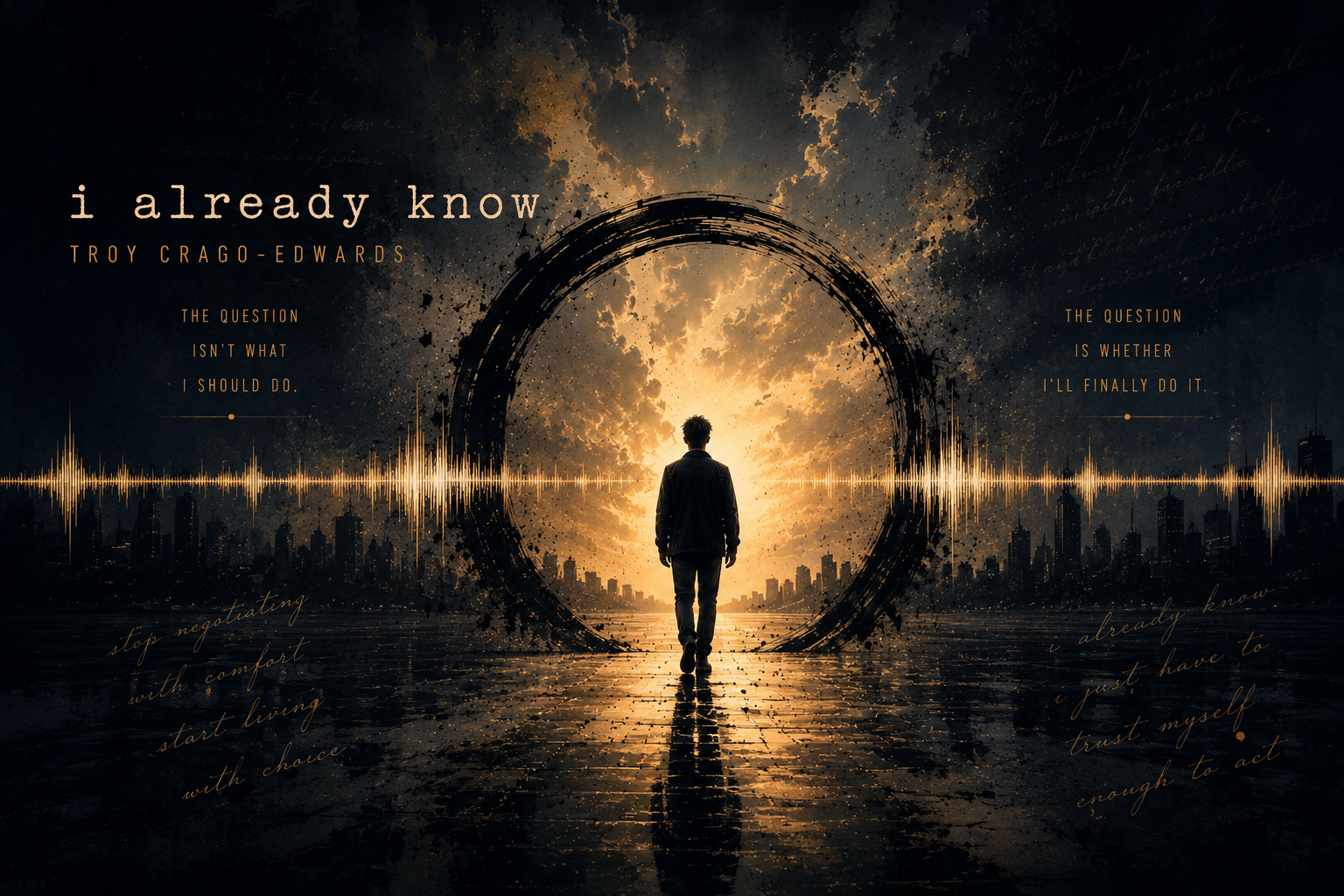
i already know
There is a point in healing when asking why starts to become another way of staying where you are.
.
I don’t mean that the questions aren’t important. Some of them are enormously important. I’ve spent enough time in therapy to know that understanding why we respond the way we do can be transformative. There is something liberating about discovering that a behavior you spent years criticizing in yourself once had a perfectly reasonable purpose.
.
But I’ve also discovered that I can turn understanding into an endless investigation.
.
And I’m very good at investigating myself.
.
I can take a feeling apart until there are pieces scattered across the table. I can trace a reaction backward through relationships and experiences and childhood and trauma. I can construct twenty different explanations for why something happened, then construct twenty different arguments against each one.
.
Give me enough time and I can make uncertainty out of almost anything.
.
That probably explains why i already know had to come after the boy in the photograph. Those two songs belong together for me… in fact, it was originally written as one song, but I quickly realized each part needed its own space to breathe and grow.
.
the boy in the photograph is an investigation. It looks backward through old photographs and memories searching for the person I thought had disappeared somewhere along the way. I imagined memory as evidence and myself as the detective trying to solve a crime that happened decades ago.
.
My favorite line from that song remains:
I kept interrogating memory.
Memory never confessed.
.
And eventually I had to ask myself something uncomfortable… what if memory wasn’t confessing because I already knew?
.
Not every detail. Not every explanation. Certainly not every answer. But enough.
.
Maybe there comes a point when the detective has to stop rearranging the evidence. Maybe eventually you have to decide what you’re going to do with what you’ve learned.
.
That’s where i already know begins.
.
.
I’ve spent a remarkable amount of my life preparing for things that never happened. Conversations are probably the best example. Someone else may think we’re having one conversation… inside my head, I’ve already had twenty.
.
I’ve anticipated what they might say. I’ve constructed my response. I’ve imagined how they might interpret that response. I’ve revised it. I’ve imagined the misunderstanding that revision might create. I’ve prepared for anger. I’ve prepared for rejection. I’ve prepared for silence.
.
Sometimes I’ve prepared for endings…
Yet the actual conversation hasn’t even started.
.
For a long time, I thought this was simply overthinking. Now I understand it somewhat differently.
.
There is safety in rehearsal.
.
If you’ve imagined every possible outcome, perhaps nothing can surprise you. If you’ve already experienced the worst ending internally, perhaps you don’t have to experience the terrifying vulnerability of simply waiting to see what happens.
.
The problem though is that the body doesn’t necessarily understand that these things are rehearsals. I’ve lived through arguments that never happened. I’ve felt rejection from words nobody actually said. I’ve mourned endings that existed only inside me. I’ve experienced alternate versions of my life without ever leaving the room.
.
That’s exhausting.
.
And, at some point, all that preparation stops protecting you and starts preventing you from living.
.
.
There is a phrase I’ve been thinking about a lot: You already know what to do. You’re just negotiating with comfort.
.
When I first encountered that idea, it sounded almost empowering. Just make the decision. Stop hesitating. Move.
.
But the more I sat with it, the more complicated it became, because sometimes what looks like comfort isn’t comfortable at all. Sometimes it’s familiarity. And familiarity can feel remarkably similar to safety, even when it hurts.
.
We know how to survive familiar pain. We’ve practiced. We know where to stand. We know when to become quiet. We know what versions of ourselves the situation requires. We know which conversations to avoid and which parts of ourselves are easier to leave outside the room.
.
The unknown doesn’t offer any of those guarantees. So we negotiate…
.
Maybe if I wait.
Maybe if I explain it differently.
Maybe if I understand one more thing.
Maybe if I become a little easier to understand.
Maybe if I needed less.
Maybe if I can finally find exactly the right words.
.
That last one is particularly familiar to me, because there is always another version of the sentence. There is always another draft. There is always another possibility where everything turns out differently.
.
And if your mind is capable of generating a thousand endings, it becomes incredibly tempting to believe there must be one more you haven’t considered. The one where nobody gets hurt. The one where everyone understands. The one where you finally explain yourself perfectly enough that another person sees exactly what you see. The one where nothing has to change.
.
I’ve spent a lot of time searching for that version…
.
I’m not sure it exists.
.
.
That’s part of what i already know means to me. It isn’t certainty - that’s important.
.
I don’t suddenly know exactly who I am or where I’m going. I haven’t solved every mystery the boy in the photograph was investigating. There are things about my past I will probably continue discovering for the rest of my life.
.
And there are wounds that understanding doesn’t erase.
.
But there is a difference between not knowing everything and knowing nothing. I think I’ve confused those two things before.
.
I’ve sometimes treated the absence of absolute certainty as evidence that I wasn’t ready to make a decision. Maybe I needed another conversation. Another explanation. Another insight. Another scenario. Another chance. Another answer.
.
But eventually I started noticing something… underneath all those voices debating possibilities, there was another voice. It wasn’t particularly loud. It didn’t argue. It didn’t present evidence. It didn’t need twenty scenarios. It simply knew. And perhaps that’s why I had such difficulty hearing it.
.
I’ve spent so much of my life believing that the safest answer must be the one I’ve examined from every possible angle that I didn’t know what to do with an answer that arrived quietly. No committee meeting. No closing argument. No cross-examination.
.
Just…
.
I know.
.
.
That doesn’t mean acting on what you know is easy. Sometimes knowing is the easy part. Living accordingly is terrifying, because once you admit that you know something, you lose one of uncertainty’s greatest gifts:
.
The ability to postpone what comes next.
.
You can no longer say you’re waiting for clarity. Clarity showed up. Quietly. Probably much earlier than you wanted to admit. Now you have to decide whether you’re willing to trust it.
.
And I think that may be one of the more difficult things healing asks of us. Not simply learning to trust other people, but learning to trust ourselves. To trust that the person who survived everything before this morning might actually recognize what he needs now. To trust that discomfort doesn’t necessarily mean danger. To trust that uncertainty doesn’t necessarily mean stop. To trust that walking away from something familiar isn’t the same thing as running away. To trust that choosing yourself doesn’t require proving that everyone else was wrong.
.
Sometimes nobody has to be the villain.
.
Sometimes something simply no longer fits the person you’re becoming.
..
.
That’s why the relationship between the boy in the photograph and i already know matters so much to me.
.
The first song looks backward. The second begins turning around.
.
In the boy in the photograph, I’m standing over the evidence asking, “what happened to me?” By the end, I realize the boy I thought had disappeared had actually survived.
.
And then i already know asks the question that realization eventually creates: now what?
.
Finding him can’t simply become another thing to analyze. I don’t want to rescue the boy in the photograph only to make him sit through another interrogation. At some point he deserves to leave the room.
.
So do I.
.
Maybe that’s what I’m beginning to understand about healing. It isn’t the moment when all the voices finally agree. I’m not convinced mine ever will.
.
Maybe healing is learning that they don’t have to. The frightened voice can be afraid. The analytical voice can keep asking questions. The part of me that wants certainty can continue drawing diagrams of every possible future. The part that grieves can grieve. They can all come along.
.
They just don’t all get a vote anymore.
.
Because beneath all that noise, there is another voice I’ve spent most of my life learning how to hear. And increasingly, when everything else finally becomes quiet enough, I recognize him.
.
He doesn’t have another question.
.
He doesn’t need another scenario.
.
He isn’t asking memory to confess.
.
He already knows.
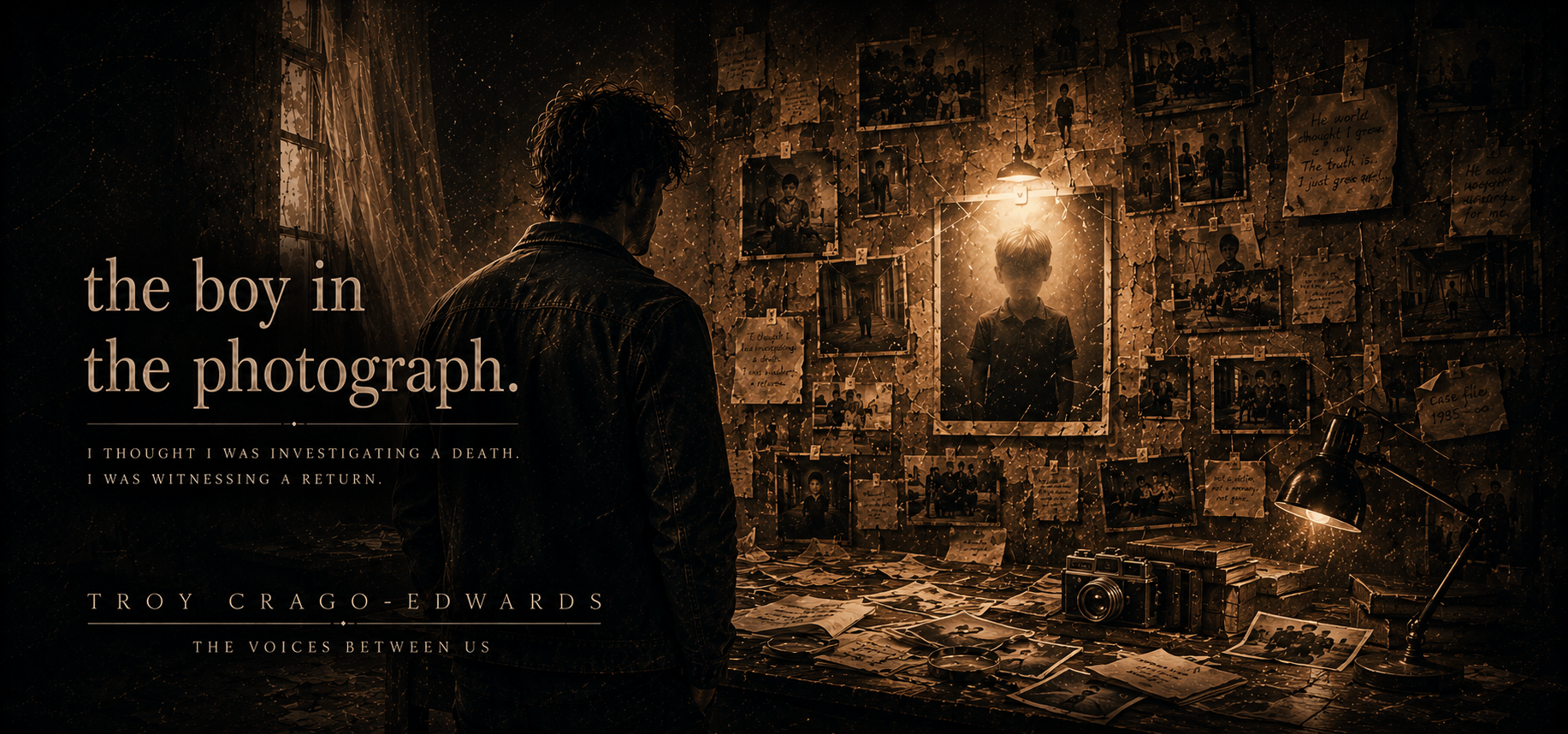
the boy in the photograph
Sometimes I look at old photographs of myself and feel like I’m looking at a murder victim.
.
I know how dramatic that sounds.
Maybe that’s why the thought stayed in my head for so long before I allowed myself to say it aloud.
.
There are photographs where I recognize the place. I recognize the clothes. I remember the people standing just outside the frame. I know, intellectually, that the person looking back at me is me.
.
But sometimes I don’t know him.
.
Or maybe that’s not quite right… sometimes I know him too well.
.
I know things he doesn’t know yet.
.
I know which parts of him will become dangerous to reveal. I know which things he’ll learn to hide. I know how good he’ll eventually become at reading a room before deciding how much of himself is safe to bring into it.
.
I know how quiet he’s going to become.
.
And there is something profoundly strange about looking into the eyes o someone who doesn’t know what you know about his life.
.
For years, I think I approached those photographs almost like evidence. If I looked long enough, maybe I could find the moment everything changed. Maybe there would be something in his expression. A clue. A before and an after. Something I could point to and say, “There. That’s where he disappeared.”
.
Trauma does strange things to memory. There are things I remember with extraordinary clarity — the kind of clarity where I can still feel the temperature of the room — and other things that seem to exist only in fragments. Images without context. Feelings without dates. Reactions whose origins I can understand intellectually but can’t necessarily trace backward in a straight line.
.
So I kept going back. Turning things over. Replaying conversations. Reconstructing moments. Trying to understand whether the person I became was always going to be this person, or whether somewhere along the way survival quietly took the pen and started writing for me.
.
That is where my favorite line in the boy in the photograph came from:
.
“I kept interrogating memory.
Memory never confessed.”
.
Of everything I’ve written in the song, those may be the words that feel most true.
.
Because I have interrogated memory.
.
I’ve put it under the brightest light I could find and asked it the same questions in a hundred different ways.
.
When did this start?
Why do I do this?
Why do I go quiet?
Why does my mind prepare for conversations that haven’t happened yet?
Why can twenty possible endings occur inside me while everyone else thinks we’re having only one conversation?
Why do I sometimes feel safer disappearing inside myself than risking being misunderstood outside of it?
.
Memory has offered evidence. It has offered possibilities. It has offered enough fragments for therapy and time and age to help me understand things I couldn’t understand when I was younger.
.
But it has never confessed.
.
There was never one moment when everything suddenly made sense.
.
And maybe that was the mistake..
.
I thought healing meant solving the case. I thought if I understood enough about what happened to me, eventually I could draw a clean line from that boy to this man and explain every decision, every relationship, every coping mechanism, every silence along the way.
.
But human beings aren’t equations.
.
There isn’t always an answer at the bottom of the page… sometimes, there is only understanding. And compassion. Those have been harder for me.
.
Understanding why I became certain things is relatively easy. Having compassion for the person who needed to become them is something else entirely.
.
For much of my life, I was enormously proud of my independence. My ability to handle things. My ability to keep going when things became difficult. My ability to walk into chaos and somehow figure out what needed to happen next.
.
People could depend on me. I could depend on me. There is nothing inherently wrong with any of those things. But OI’m beginning to understand that some of the qualities I thought were simply me may also have been extraordinary sophisticated ways of staying safe.
.
The world thought I grew up. The truth is, in some ways, I just grew quiet.
.
I learned how to function. I learned how to smile. I learned how to make people laugh. I learned how to succeed. I learned how to be the person who could carry more. And because I was so good at carrying it, very few people ever thought to ask how heavy it was.
.
For a long time, neither did I.
.
That’s part of why I didn’t want this song to be another quiet piano ballad. Quiet would have been beautiful. It also would have been wrong. My mind isn’t quiet when I look backward. It searches. It argues. It reconstructs. It finds something and immediately finds evidence against it. It opens one door and discovers six more behind it.
.
So the boy in the photograph became stranger musically than much of what I’ve been writing lately. Harder. More experimental. At times intentionally unsettled.
..
I wanted the music to sound a little like memory feels to me. Not chronological. Not obedient. Not particularly interested in resolving itself just because I would like it to.
.
And somewhere in writing the song, something happened that I hadn’t planned.
.
The metaphor changed.
.
I had begun with a murder victim. That meant I had spent all this time searching for a death. Trying to determine when that boy disappeared. Trying to understand what killed him. Except eventually I had to confront a possibility I hadn’t considered.
.
What if nobody killed him? What if he never disappeared? What if all those things I had interpreted as evidence of his absence were actually evidence of how desperately he had fought to remain?
.
Maybe the silence wasn’t his grave. Maybe it was his hiding place. Maybe the independence wasn’t proof that he stopped needing anyone. Maybe it was how he made certain he could survive if nobody came. Maybe all those versions of me I’ve spent years examining weren’t the people who replaced him. Maybe they were the people he created to keep himself alive.
.
And suddenly I wasn’t looking at a murder victim anymore. I was looking at a boy who had been waiting an extraordinarily long time for someone to recognize him.
.
The detective in me still wants answers. I suspect he always will.
.
There are questions about my life that memory will probably never answer to my satisfaction.
.
There are things trauma changed that healing cannot go backward and undo
.
There are versions of my life I will never know. I’ve grieved some of them. I probably haven’t finished grieving all of them.
.
But I don’t look at the photograph quite the same way anymore because perhaps healing was never supposed to bring the person I would have been if nothing had happened. Perhaps that is another imaginary person I’ve been mourning
.
The boy who actually existed did something much more remarkable.
.
He stayed. Quiet. Imperfectly. Sometimes destructively. Sometimes brilliantly. He adapted. He hid. He became whatever he thought he needed to become. And he waited.
.
I thought I had spent all these years investigating his death. It took me a long time to understand that I was witnessing his return.
.
And now I find myself wondering about something I never thought to ask before.
.
Not what happened to him. Not who he might have become. Not even what was taken from him…
.
I wonder what happens next.
.
Because maybe finding the boy in the photograph isn’t the end of the investigation.
.
Maybe it’s the first time in his life that nobody else gets to decide who he becomes.

the one who wrote the songs
I thought I was writing songs to explain my life. Instead, they quietly became the path back to the person who had been writing them all along. This is the story behind the one who wrote the songs—and the unexpected discovery that changed far more than its title.
Every once in a while, a song arrives that changes something in you. Not because you wrote it particularly well, or because you finally found the perfect lyric, but because somewhere in the process it quietly tells you something you didn’t know until you heard it for yourself.
..
That’s what happened with the one who wrote the songs.
.
For most of its life, this song wasn’t called that at all. I was convinced it was going to be MY NAME IS TROY. In my mind, it was going to be a declaration — a cinematic moment of finally standing in my own identity after years of surviving, adapting, and becoming whatever each season of life required. It felt powerful. It felt triumphant.
The problem was, it didn’t feel true.
.
Every time I tried to make the song bigger, it somehow became smaller. Every attempt to turn it into an anthem pulled it further away from what I was actually trying to say. I couldn’t understand why until one line appeared almost out of nowhere:
.
“I just don’t think they’ve met the one who wrote the songs.”
.
When I read those words back to myself, everything stopped.
..
I realized I wasn’t writing about introducing myself to anyone else. I was writing about recognizing a part of myself that had quietly existed underneath every version of me the world had come to know.
..
We all create those versions, don’t we? The dependable one. The strong one. The patient one. The one who always knows the answer. The one who keeps the peace. They’re not dishonest versions of us — they’re often the parts that carried us through seasons we couldn’t have survived otherwise. They deserve gratitude.
..
But they’re not always the whole story.
..
As I continued writing, I found myself thinking about every song I’ve created over the past several years. I had always assumed they were reflections of my life, snapshots of experiences, relationships, grief, hope, healing. Looking back, though, I began to wonder if I’d had it backwards all along. Maybe I hadn’t been writing songs to explain my life. Maybe the songs had quietly been leading me back to the person who was writing them.
..
That realization changed eveything.
..
The title changed. The ending changed. Even the music changed. What had started as a declaration slowly became a conversation, and then something even quieter than that. Instead of announcing who I was, the song became an acknowledgment that perhaps the person I’d been searching for had never actually been missing. Maybe I had simply spend so many years becoming what I needed to become that I’d forgotten to look beneath it.
..
Ironically, that’s exactly how this song came into existence.
..
Normally I rewrite endlessly. I’ll question every lyric, every melody, every phrase. I’ll convince myself something isn’t quite right and spend days trying to improve it. This song refused to let me do that. The first complete version made me cry — not because I thought it was perfect, but because it felt unmistakenly honest. I lived with it for days afterward, listening while I drove, while I ran errands, while I did ordinary things. I kept expecting to discover the line that needed rewriting.
..
It never came.
...
For the first time in my life, I found myself looking at a finished song and realizing I didn’t want to change a single word.
..
That may be the greatest gift this song gave me.
..
If you’ve followed my music for a while, you may notice that many of my earlier songs ask difficult questions. They wrestle with grief, identity, trauma, love, regret, and hope. They reach for answers without pretending they’ve found them. the one who wrote the songs feels different. It doesn’t answer every questions those songs asked, but somehow it no longer needs to. It simply sits beside them with a quiet confidence, as if to say, “We’ve come far enough.”
..
More than anything, I hope listeners don’t hear this as only my story.
..
I hope they hear their own.
..
I hope it gently asks what became the question I couldn’t stop asking myself while writing it: Who is the one beneath your survival? Who is the version of you that has been patiently waiting while you became eveything everyone else needed you to be?
..
Maybe you’ve never actually lost that person.
..
Maybe you’ve simply been taking the long way back.
..
When I finished this song, I realized something that caught me completely by surprise. I wasn’t only writing these songs for the people who would eventually hear them.
..
Somewhere along the way, they had quietly became the map that led me home.
.
And perhaps that’s who the one who wrote the songs has been all along.
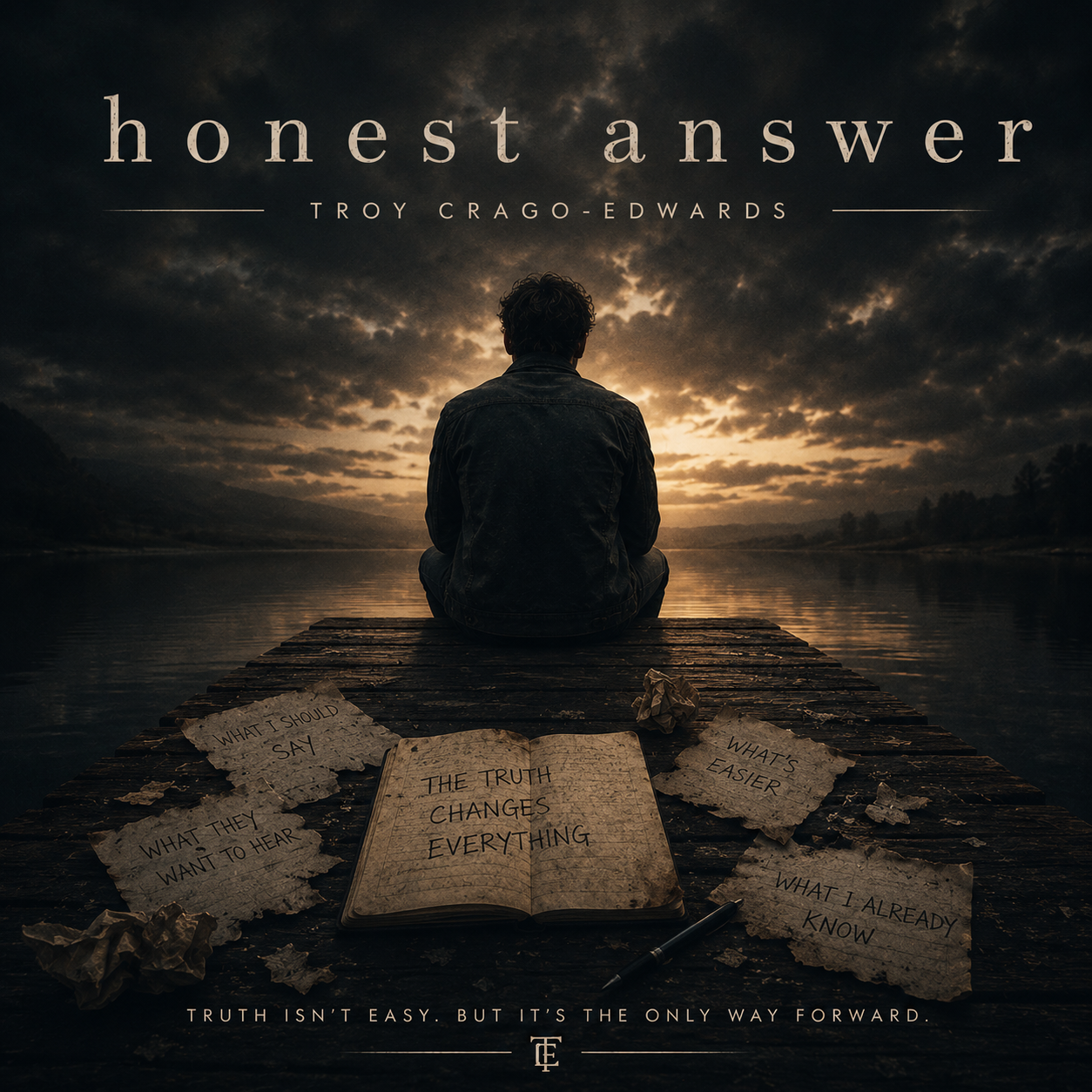
honest answer
People asks each other, “How are you?”
.
Most of the time, it’s a greeting, not a question. And most of the time, we answer the same way.
.
“I’m fine.”
“Doing okay.”
“Can’t complain.”
.
Sometimes those answers are true. Sometimes they are close enough. And sometimes they’re nowhere near the truth.
.
I’ve spent a lot of my life becoming very good at translating what I actually feel into something that’s easier for other people to hear. Not because anyone asked me to. Not because I wanted to be dishonest. But because it often felt simpler than trying to explain what was really happening inside my head.
.
How do you tell someone you’re emotionally exhausted without making them feel responsible?
.
How do you explain that your mind has been having the same conversation on repeat for hours — or days — before you’ve spoken a single work out loud?
.
How do you put language around a kind of loneliness that can exist even when you’re surrounded by people who love you?
..
Sometimes there aren’t words… sometimes there are only songs.
.
honest answer came from wondering what would happen if someone asked me how I was doing, and instead of giving the expected answer, I gave the real one. Not the polite version. Not the shorter version. Not the version that protects everyone else from feeling uncomfortable.
.
The honest answer.
.
Writing this song was uncomfortable. Sharing it feels even more vulnerable, because once something is spoken out loud, it stops being hypothetical. It becomes real. It becomes something another person can respond to — or misunderstand.
.
That can be terrifying.
.
But I’ve also started to believe something I didn’t always believe: honesty doesn’t guarantee connection. It doesn’t guarantee people will understand. It doesn’t guarantee they’ll stay.
.
But without honesty, real connection never has a chance.
.
If you’ve ever smiled because it was easier than explaining…
.
If you’ve ever answered, “I’m fine,” because you didn’t know where to begin…
.
If you’ve ever felt like the version of yourself everyone sees is only a small piece of what’s actually happening inside…
.
I hope this song reminds you that you’re not the only one.
.
Maybe the bravest thing we ever say isn’t something profound.
.
Maybe it’s simply the honest answer.
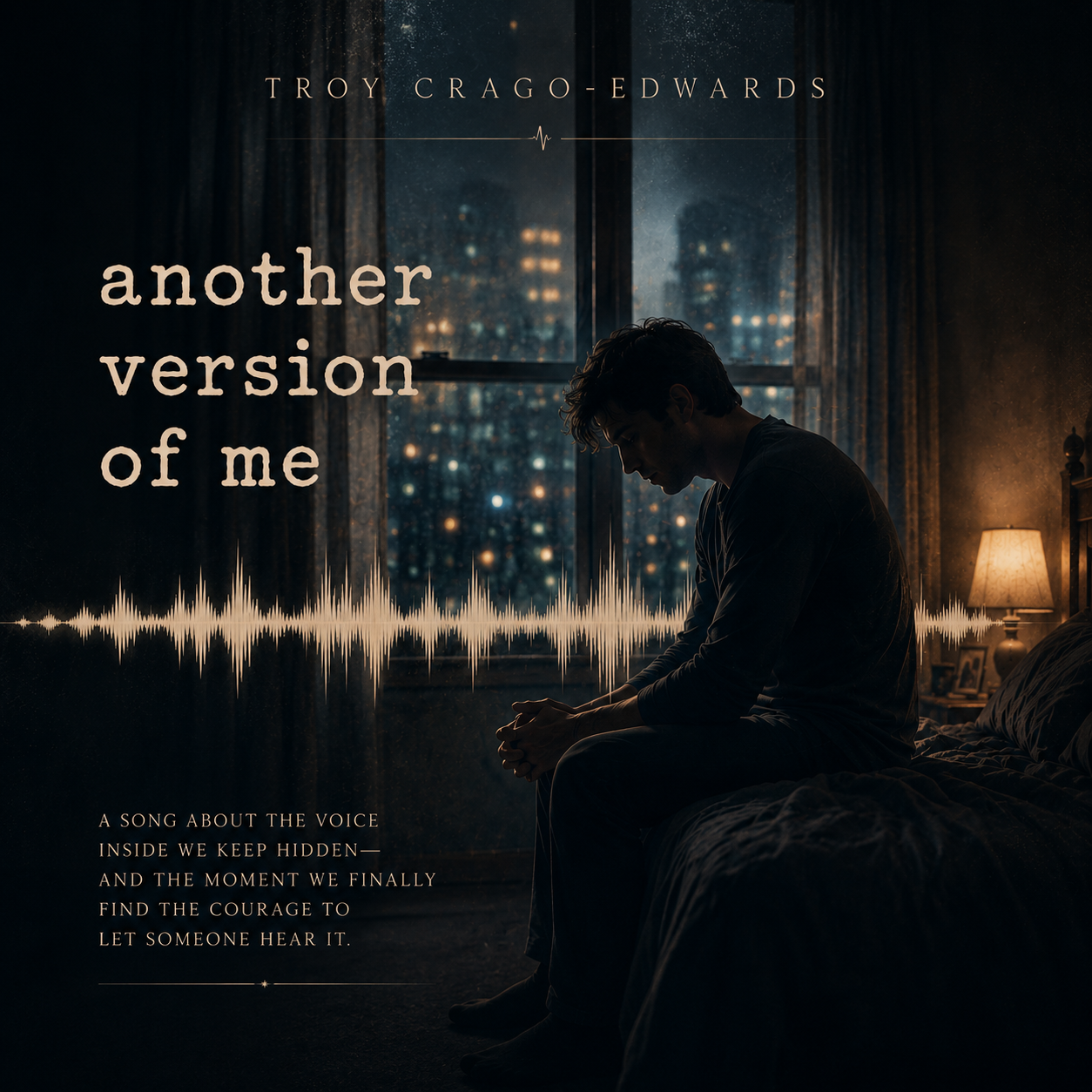
another version of me
There is a version of me that most people know.
.
He’s the one who goes to work, makes people laugh, solves problems, writes music, keeps moving forward, and somehow always seems to have everything under control.
.
And then there’s another version.
.
The one who lies awake replaying conversations that ended hours, days, or even years ago. The one whose mind never seems to stop. The one who has imagined a thousand different futures — most of them painful — that never actually happened anywhere except inside his own head.
.
For a long time, I honestly believed everyone experienced life this way.
.
I thought it was normal to carry dozens of conversations at once, to rehearse every possible outcome before speaking, to relive old memories searching for the moment where everything might have turned out differently. I thought everyone smiled while quietly carrying parts of themselves they couldn’t find the words to explain.
.
Maybe some people do.
.
But I’ve slowly realized that many of us also spend an incredible amount of energy convincing the world we’re okay when we’re not.
.
Looking back, I don’t think the hardest part of this past year was my marriage ending.
.
It was realizing how much of myself had remained hidden — even from the person I loved most.
.
I’ve asked myself the same questions more times than I could ever count: What if I had found the words?
.
Would he have understood what was happening inside my mind?
.
Would he have recognized that I wasn’t pulling away from him — I was trying to escape the relentless noise inside myself?
.
Would he have listened?
.
Would he have believed me?
.
Would anything have been different?
.
I’ll never know.
.
And I’ve finally made peace with the fact that I never will.
.
This song isn’t an attempt to rewrite the past or to answer questions that don’t have answers.
.
It’s simply the first time I’ve stopped pretending that the version of me everyone else saw was the only one that existed.
.
What has surprised me most over the last few years isn’t how unique my story is… it’s how common it is.
.
Every time I’ve shared something I thought was too personal, too painful, or too embarrassing to say aloud, someone has quietly reached out and said, “I thought I was the only one.”
.
Those words have changed me.
.
They’ve made me realize that silence doesn’t protect us nearly as much as we think it does.
.
Sometimes it isolates us.
.
Sometimes it convinces us we’re carrying something no one else could possibly understand.
.
And sometimes all it takes is one person speaking honestly for someone else to realize they don’t have to carry their story along anymore.
.
That’s what this song has become for me.
.
Not a confession, but an invitation.
.
If you’ve ever felt like there was another version of yourself that no one really ever knew…
.
If you’ve ever smiled while quietly falling apart…
.
If you’ve ever wondered whether sharing the truth would make people leave…
.
I hope this song reminds you of something I’m still learning myself.
.
Being heard is not the same thing as being a burden.
.
You deserve to be known.
.
And if these songs have taught me anything, it’s this:
.
Every voice begins with someone believing it’s finally safe to speak.
.
Maybe this song can be that place for someone else.
.
Maybe it can be that place for you.
.
It certainly has been for me.

the echo between us
There comes a moment when we stop asking what happened.
Not because every question has been answered.
But because we slowly begin asking different ones.
Who have I become?
What stayed with me?
What part of that life still exists inside this one?
That is where the echo between us begins.
.
after the quiet
If the quiet between us explored the emotional distance that slowly grows between two people, the echo between us explores what remains after that distance has become part of the past.
The conversations have ended.
The decisions have been made.
Life has continued.
Yet memory has its own rhythm.
Some experiences never truly disappear.
They simply echo differently over time.
.
memory changes shape
One of the surprising things about healing is that memory rarely stays the same.
What once felt unbearable slowly becomes bittersweet.
What once felt impossible to revisit eventually becomes something we can hold with gratitude.
That transformation became the foundation of this collection.
These songs are not attempts to relive the past.
They are attempts to understand what the past continues to teach us.
.
carrying what remains
Throughout these songs, certain images return again and again.
Open skies.
Echoes.
Fragrance.
Architecture.
Space.
Horizons.
Rooms that feel different after someone leaves.
The invisible outlines people leave inside us.
These are not symbols of loss alone.
They are reminders that every meaningful relationship changes us in some way.
Even when it ends.
Especially when it ends.
.
rebuilding through music
The companion warehouse recordings became an important part of this chapter.
Unlike the originals, which often invite quiet reflection, these versions explore movement.
Not movement away from the past.
Movement through it.
Industrial rhythms.
Cinematic synths.
Expansive spaces.
The same emotions transformed into something physical.
The warehouse versions are not escapes from vulnerability.
They are expressions of resilience.
They acknowledge that healing is rarely still.
Sometimes it asks us to dance with what once broke us.
.
gratitude without forgetting
One of the ideas that kept returning while writing these songs was that gratitude and grief are not opposites.
They often exist together.
We can miss someone deeply while remaining thankful they were ever part of our lives.
We can mourn what ended while honoring what it gave us.
Many of these songs live inside that tension.
Not because it is comfortable.
Because it is honest.
.
the second chapter
Although the echo between us continues the emotional journey that began with the quiet between us, it stands on its own.
This is not an album about returning to the past.
It is about carrying the past forward differently.
The echoes are no longer obstacles.
They become part of the landscape.
Part of the person.
Part of the music.
.
what I hope you hear
I hope these songs remind you that healing is not forgetting.
It is learning to live alongside memory without allowing it to define every step forward.
If these songs encourage you to revisit your own story with a little more compassion...
If they help you recognize beauty where you once saw only loss...
If they remind you that rebuilding is possible...
Then they have already found the place they were meant to belong.
Because the quiet may have ended.
But the echo continues.
And sometimes...
That echo becomes the beginning of something entirely new.

the quiet between us
There are moments in every relationship that seem insignificant while they are happening.
A conversation postponed.
A question left unanswered.
A silence that lasts a little longer than it used to.
A room that somehow feels different even though nothing inside it has changed.
Most relationships do not end all at once.
They change quietly.
Almost invisibly.
the quiet between us was born from trying to understand those moments.
Not the dramatic ones.
The quieter ones that reshape everything without announcing themselves.
.
an album about emotional distance
At its heart, this album explores the slow transformation of two people who once felt inseparable.
Not because love was absent.
But because understanding gradually became harder to find.
The songs move through memory, longing, identity, grief, vulnerability, hope, and acceptance without trying to simplify any of them.
There are no easy conclusions here.
No heroes.
No villains.
Only people trying to understand one another while carrying different histories, fears, and expectations.
.
the language of the album
As the songs developed, I noticed they kept returning to the same images.
Rooms.
Architecture.
Weather.
Open skies.
Shadows.
Silence.
Distance.
None of these were planned.
They simply became the vocabulary through which the music learned to speak.
Over time, those images formed a world that felt larger than any one song.
.
writing without certainty
I rarely begin with a complete story.
More often, I begin with a feeling I cannot quite explain.
Sometimes that feeling becomes a melody.
Sometimes it becomes a single lyric that refuses to leave me alone for weeks.
Many of these songs changed dramatically while they were being written.
Others remained remarkably close to their earliest forms.
Rather than chasing perfect answers, I tried to stay honest to whatever emotion first inspired each piece.
That honesty became more important than certainty.
.
acoustic and warehouse
Many listeners ask why the album includes warehouse reinterpretations alongside intimate acoustic recordings.
The answer is simple.
Emotions rarely exist in only one form.
Some memories ask us to sit quietly.
Others demand movement.
The original recordings invite reflection.
The warehouse versions transform those same emotions into rhythm, atmosphere, and momentum without changing their emotional core.
They are not alternate songs.
They are alternate perspectives.
.
more than a breakup album
Although many of the songs were inspired by the end of a marriage, I never wanted the album to become only about one relationship.
Because, ultimately, it is not.
It is about connection.
About misunderstanding.
About becoming invisible to someone who once knew you completely.
About discovering pieces of yourself after everything familiar has changed.
That is why listeners often tell me the songs remind them of a parent, a friendship, a sibling, or even a version of themselves they thought they had lost.
Once the music belongs to you, your story becomes just as important as mine.
.
the beginning of something larger
When I finished the quiet between us, I believed I had reached the end of the story.
Instead, I had unknowingly written the first chapter.
Those songs opened the door to what has become the between series, an ongoing exploration of the emotional spaces that exist between people, between endings and beginnings, between silence and echo, between collapse and reconstruction.
This album will always be where that journey began.
Not because it answered every question.
But because it gave me permission to start asking them.
.
thank you for listening
Whether you arrived here because one song found you at exactly the right moment, or because you've listened from the very beginning, thank you.
Music has always been the place where I try to understand experiences that are too complicated for ordinary conversation.
If these songs have helped you remember someone, grieve something, forgive someone, or simply feel a little less alone, then they have already become more than I ever hoped they would.
The quiet between us may have been where this journey began.
But every listener who carries these songs with them becomes part of where it goes next.
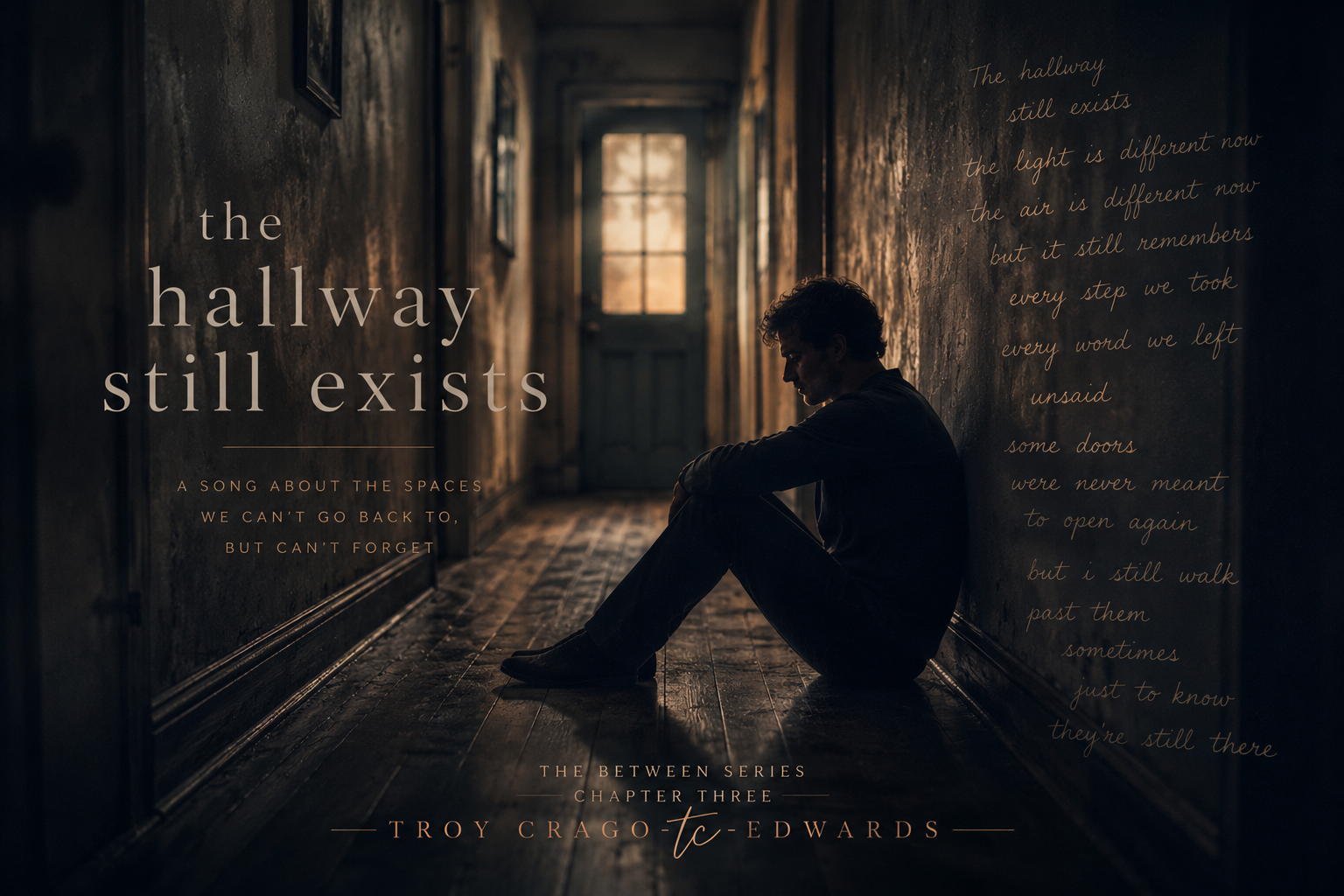
the hallway still exists
There are places that quietly disappear from our lives.
.
We move away. Buildings are remodeled. Businesses close. Schools are torn down. Homes belong to someone else.
.
And yet…
.
They never really leave us.
.
Sometimes all it takes is a certain smell, a photograph, or walking down a hallway that looks vaguely familiar, and suddenly you’re no longer standing where you are.
.
You’re standing there.
.
I’ve come to believe that memory doesn’t just live in our minds. It lives in places.
.
Certain rooms become forever attached to the moments that happened inside them. They stop being architecture and become emotional geography. They become witnesses.
.
That’s where the hallway still exists began.
.
For me, the hallway in this song represents a place where something happened that fundamentally changed how I moved through the world afterward.
.
Like many survivors, I spent years believing that healing meant someday reaching a point where those places no longer held power over me. But healing, at least in my experience, hasn’t meant forgetting. It has meant learning that I can walk through those memories without letting them define where I’m going.
.
One of the reasons I wanted to write this song is because conversations about assault often focus — rightly — on women. But men experience sexual assault, abuse, coercion, and violence too. Far less often do they feel safe talking about it.
.
There are many reasons for that. Shame. Disbelief. The expectation that men are always supposed to be strong. The fear that people won’t understand.
.
Or simply not having the words.
.
I know how isolating that silence can become.
.
This song isn’t an attempt to relive what happened. It’s an acknowledgement that trauma has a remarkable way of attaching itself to ordinary places. A hallway. A parking lot. A classroom. A hotel room. A hospital corridor. A doorway.
.
To everyone else, they’re just places. To someone who lived through something there, they become landmarks in an emotional landscape that can take years to understand.
.
That’s why I wrote:
“the hallway still exists.”
.
Not because I want to go back. Not because I’m trapped there. But because pretending those places don’t matter has never been what healing looked like for me.
.
Healing has been learning that those places can continue to exist…
.
Without continuing to own me.
.
For years, I carried this story quietly. Not because it didn’t matter, but because I didn’t yet believe it belonged in the world.
.
Then I watched Dr. Christine Blasey Ford testify before the Senate.
.
Whatever people’s opinions may be about the events that followed, one thing stayed with me: I watched someone speak publicly about an experience they had carried for decades. I saw the vulnerability it required, the criticism it invited, and the extraordinary courage it took simply to tell the truth as she remembered it.
.
Watching her speak didn’t give me my story. It gave me something I hadn’t realized I was missing: the belief that one day it might be safe to tell it.
.
Looking back, I think that’s where this chapter truly began.
.
Every voice begins the moment someone believes it’s finally safe to speak.
.
If this song reaches someone who has carried a hallway of their own — whatever happened there — I hope it reminds you that you’re not alone.
.
Some places become more than locations. They become witnesses.
.
And sometimes the bravest thing we can do isn’t erase them. It’s to keep walking.
.
-Troy

going, going, gone
his fragrance filled the air, then my mind began to go…
Some songs begin with a melody. This one began with a single line that I wrote down years ago: “His fragrance filled the air.” It stayed with me because it captured something I hadn’t found any other way to describe.
.
Scent has a way of bypassing logic. It doesn’t ask permission before it pulls you backward. For a brief moment, the past feels completely present again — not as a memory you’re choosing to revisit, but as something that simply arrives.
.
When I returned to this poem, I didn’t want to explain it away. I wanted to preserve that feeling of uncertainty. Is it grief? Longing? Love? Regret? Maybe it’s all of those things at once. The lyrics leave space for the listener to decide.
.
Musically, I imagined an arrangement that felt almost haunted — not frightening, but quietly inhabited by memory. The spaces between the notes became just as important as the notes themselves, allowing the song to breathe and linger the way a familiar fragrance does after someone has already left the room.
.
Like many of my songs, this one asks more questions than it answers. Sometimes that’s the most honest place a song can live.
.
You can listen to “going, going, gone” in the Music Catalog or on SoundCloud.
.
Thanks for listening -
Troy